

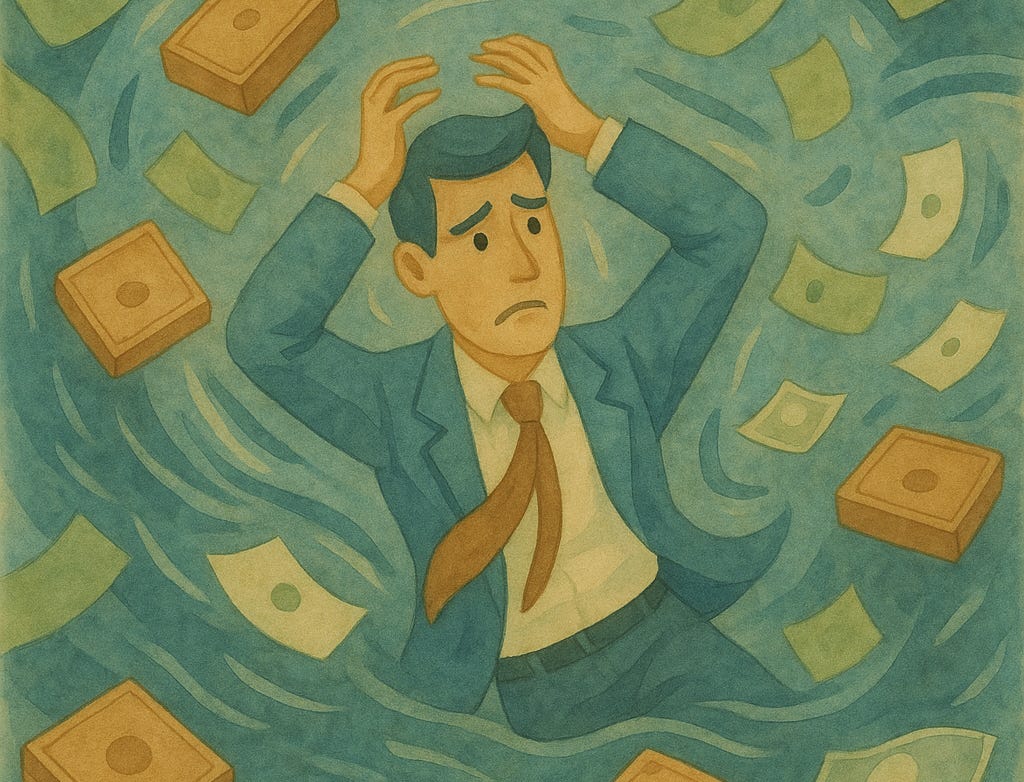
We live in a society where many of the historically stigmatized topics are now less and less taboo, such as sexuality, gender identity, mental health, etc. The drastic evolution of our beliefs and values in just over a generation of time has changed our culture significantly, even though there’s still plenty of stigma and biased opinions. In social or public settings, people can talk freely about politics, religion, spirituality, sexual orientation or health issues (like the use of Ozempic). However, very rarely do people discuss money issues, like their income or wealth. Money is still one of the last frontiers we keep close to ourselves.
It is because we don’t just hold money in our hands. We let it get into our head, and too quickly it gets to our heart.
In my work as a coach, money frequently comes up as a significant factor affecting people’s professional and personal decisions, but often in an unconscious way. People usually ignore, dismiss, or suppress the thought of money issues, hesitant to approach it directly. In this blog, I’m dissecting this topic into three aspects: economic, self-worth, and emotional, establishing a mental model that could help us uncover our unconsciousness. When we feel more comfortable calling out the elephant in the room, we are not to be blindsided by it and can make decisions with a clear mind.
Money in your hand
Money in your hand is for economic means, its basic functionality. “I have to pay the bills.” Many of my clients live in the SF Bay Area and New York. The living cost has been going up and seems to continue in the foreseeable future. To make ends meet takes a lot of hard work for many families. It is undeniable that financial pressure is a real thing for people; however, the majority of the sufferings that money costs us are actually not its pure financial implications. Let’s take a look at what they actually entail.
Money in your head
When you extend money beyond its economic means, you step onto a slippery slope. It gets from your hand to your head. Your mind starts to over-identifying with money. Before you realize it, you unconsciously equate money to your self-worth. Your annual total compensation package needs to go up because how can you be worth less as you work so hard. You are worth no more or less than your money. Then yes, of course the more the merrier. As you could imagine, this proxying could be very unhealthy. As life happens, any fluctuation in your money shakes your self-worth. Tying your identity to money is like putting fetters on yourself. You surrender your freedom and allow external forces to drag you anywhere they are going. Guess what? They are not going to always bring you to pleasant places.
Money in your heart
People not only hold money in their hands, think about it in their head, they also take it very deep into their heart. They need it as a drug to stabilize their emotions. Possessing or earning more money might be necessary to make you feel safer; while making less could be an emotional trigger for fear, anxiety and panic. These emotions do not come from simple financial calculations; instead they arise from very deep in the psyche. It’s very much like dependence on a drug. You need to continue taking it to feel centered; and not taking it could immediately invoke withdrawal symptoms. This unconscious perception of money is often rooted in a person’s family and cultural background. Growing up from a lower socioeconomic status with a constant lack of money could have a lasting impact on how people perceive money, even if later in life they become much more financially stable. This happens quite a lot for first-generation immigrants or self-made high-achievers who had to pursue their dream starting from scratch. They might have “made it” or realized their dream from an objective point of view; however, they continue living and operating in a dream mode, unconscious about how their emotional dependence on money still drives their every decision and action.
How to maintain a healthy relationship with money
As we discussed various ways that people could become unconscious on how they perceive money, how shall we cultivate a more conscious view and maintain a healthy relationship with money? I invite you to a very simple practice. Next time when you have an uncomfortable feeling about money, such as making a large purchase, filing your tax return, or asking for a raise from your employers. Notice your thoughts and emotions such as doubt, excitement, fear, dreadfulness, or whatever it may be. Take a moment to recognize it and check the underlying motivations. There might not be right or wrong thoughts and emotions. The key is to bring awareness of your true perception and belief, which is hugely beneficial to help you make a sound decision while cultivating a healthy and balanced relationship with money.
Keep money in hand. Be very careful when it gets into your head and your heart.