

In the rush of today’s AI gold rush, countless “smart” demos and startups crash and burn not because the technology failed, but because they solved the wrong problem. Mid-career product managers and AI-native founders can’t afford to waste months building an AI solution that no one actually needs.
The key is validation – pressure-testing your idea early, rigorously, and with the right mindset.
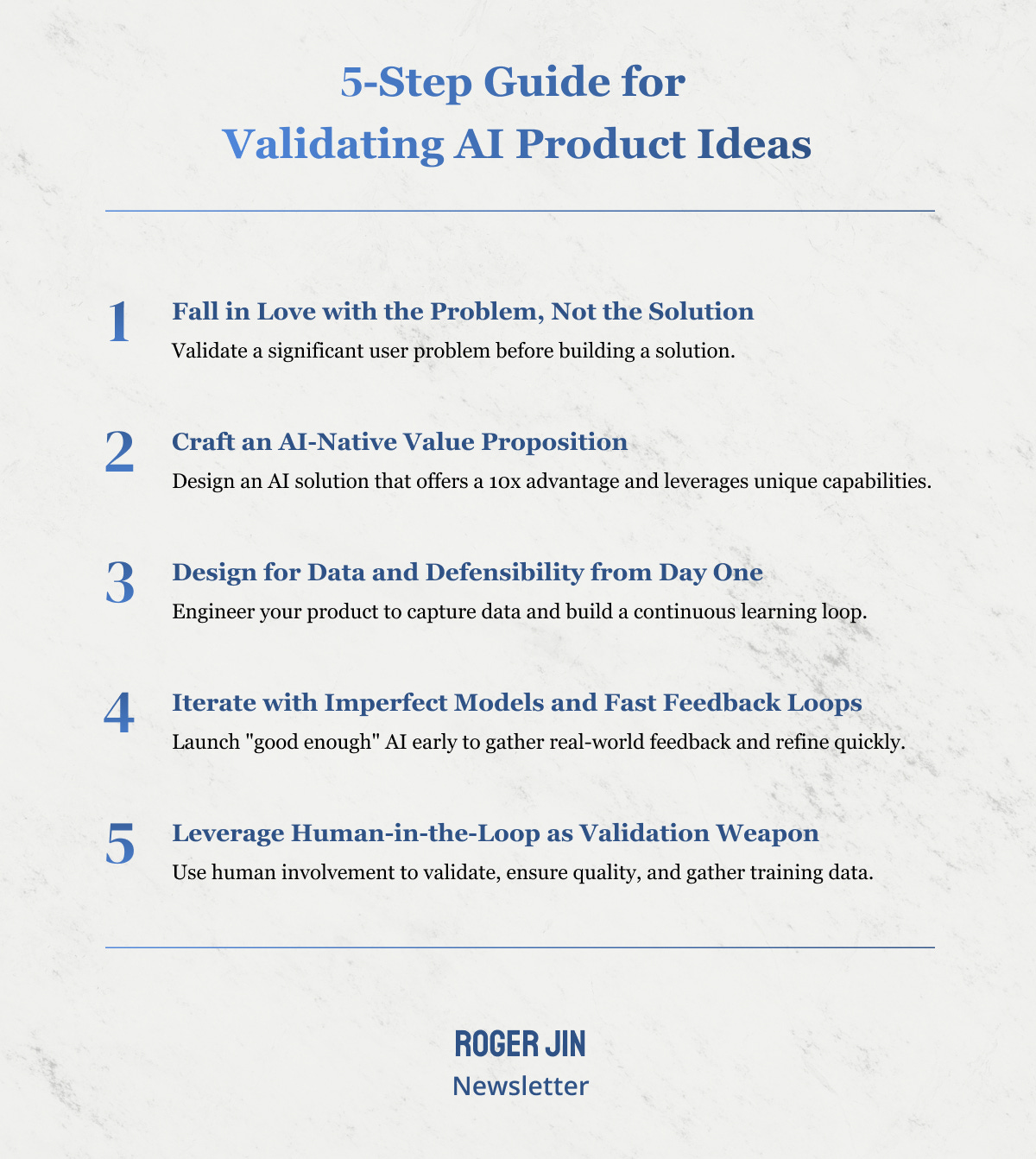
From my own experience as a founder, product leader in Big Tech as well as coaching AI founders, I summarized my learnings into this 5-step guide. Each step is a mindset shift or critical decision point, to validate an AI product idea from scratch. Follow these steps to avoid common traps (like the infamous “solution-first” AI trap), craft a compelling AI-native value proposition, design for data and defensibility, iterate quickly with imperfect models, and leverage human-in-the-loop workflows to accelerate learning. Let’s dive in.
Step 1: Fall in Love with the Problem, Not the Solution (Avoid the AI Solution-First Trap)
The biggest sin in AI product development is starting with a “cool” AI solution and then wandering around for a problem to solve. Too many founders get overly excited with a new model or capability and forget to validate if anyone actually cares. In fact, lack of market need is the #1 startup killer – about 42% of startups fail because they built something no one wanted. AI startups are especially prone to this; it’s all too tempting to create an impressive demo that ultimately addresses no urgent user pain. For example, social robot Jibo garnered media hype but struggled to find a real market demand and shut down in 2018, a cautionary tale of an AI solution in search of a problem.
The mindset shift: Start with a specific user problem – ideally an acute, recurring pain point – before you even think about the letters “AI.” Identify a target user persona and a concrete job-to-be-done. Why is it painful or inefficient today? Why haven’t existing solutions fixed it? Ground your idea in that insight.
“Successful founders are in love with their problem, usually because they are in love with the customer... The ones that are in love with their idea and their product fail in massive numbers” - David Hirschfeld
In practice, this means writing a problem statement that resonates with a real customer’s frustration, without mentioning any AI magic. If you can’t clearly articulate who you’re helping and why they desperately need a better solution, stop and refocus.
Validate the pain early: Talk to potential users, even if informally. For instance, before building anything, you might interview 5–10 people in your target audience and ask about their current workaround or pain. Look for that telltale sign of a high-value problem: users expressing relief or excitement at the idea of a solution. Make sure you’re solving a significant problem (one that affects budgets, productivity, health, etc.) and not just a minor inconvenience. The goal is to avoid the trap of a shiny AI that’s a “nice-to-have.” In summary, start with an unmet need – the sharper and more specific, the better.
Practical checklist (Problem-First Validation): Before writing a single line of code, ensure you can answer these questions:
Who exactly is the user, and what urgent problem do they face?
How do they address it today, and why is that insufficient?
If you offered a solution (even a manual one), would they realistically pay or invest time in it?
This problem-first discipline will guard you against building tech for tech’s sake. One AI founder recently scrapped months of coding after realizing he hadn’t confirmed if anyone would pay for his AI at all – he eventually went out and manually offered the service as a test, discovering that only then had he truly validated a real need.
Your customers don’t care how advanced your tech is.
They care that you solve their problem.
Step 2: Craft an AI-Native Value Proposition (Focus on a 10× Advantage)
Once you’ve identified a real problem, the next step is framing why your solution needs to be AI-powered – and how that gives you a 10× advantage over the status quo.
In my previous post, I talked about the AI Trilemma Advantage, as a mental model to realize the super power of AI in service oriented solutions.
This is a mindset shift from thinking “we’ll sprinkle in AI to sound innovative” to designing an AI-native value proposition from the ground up. Ask yourself: In what way can AI solve this problem fundamentally better or differently than traditional methods? The best AI product ideas aren’t just a little more efficient; they redefine the solution space by breaking old trade-offs. AI can often do things that were previously impossible – like providing personalization at scale, understanding unstructured inputs (language, images) automatically, or continuously learning to improve outcomes. Your value prop should hinge on one of these unique capabilities.
Think of it this way: if removing the AI from your product still leaves a viable solution, you probably haven’t pushed far enough. An AI-native product should deliver something only AI can do, or at least be order-of-magnitude better in speed, cost, or quality. For example, GitHub Copilot gives developers an “AI pair programmer” that can autocomplete code and suggest functions as they type. Just two years after launch, Copilot is already writing almost 50% of the code in projects where it’s enabled – a staggering leap in developer productivity that simply would not be possible with a non-AI tool. Another example: Khan Academy’s new tutor bot, Khanmigo, offers personalized, conversational tutoring to every student. Scaling one-on-one human tutoring to millions was impossible before; with AI, Khanmigo can coach students individually, at any hour, for virtually zero marginal cost. That’s an AI-native value proposition: something that was previously unattainable (a tutor for every child) is now within reach, courtesy of AI.
Articulate the “AI superpower”: To craft your AI-native value prop, clearly define what competitive edge the AI provides. Is it hyper-personalization (e.g. an app that adapts uniquely to each user’s behavior in real time)? Is it scalable insight (e.g. analyzing thousands of data points or documents in seconds to give an answer)? Is it creative generation (producing content, designs, or code on the fly)? Make that the centerpiece of your pitch. For instance, instead of saying “Our product uses machine learning to improve marketing emails,” you’d say, “Our AI copywriter drafts tailored emails for each customer segment in seconds, something a human team would take weeks to do.” The difference is framing the user benefit that’s unlocked by AI. A strong test is the 10× rule: if your AI solution isn’t at least 10 times faster or 10 times cheaper or enabling something 10 times more effective, go back to the drawing board. AI for AI’s sake won’t sell – users flock to AI products that feel like magic, not those that feel like ordinary products with a bit of predictive text thrown in.
Finally, avoid the trap of incrementalism. Being “AI-powered” is not a selling point on its own in 2025 – it’s about what new value AI delivers. So zoom out and describe your product’s value proposition in one compelling sentence. For example: “With our AI-driven recruiting tool, a hiring manager can screen 1,000 resumes in an afternoon and pinpoint the top 5 candidates – a process that used to take weeks.” That highlights a step-change in capability. Craft a similar AI-native value prop for your idea, and you’ll have a clear beacon to guide product development and messaging.
Step 3: Design for Data and Defensibility from Day One
In AI products, data is your moat – if you design it right. Unlike classic software, an AI product doesn’t just ship code; it continuously learns from data. This means two things: (1) Your product should be engineered from the outset to capture the critical data that makes its AI smarter, and (2) The way you collect and leverage data will largely determine your long-term defensibility against competitors. A common misconception is that you need a huge proprietary dataset upfront to have any chance at success. In reality, the new competitive moat is not about hoarding a static trove of data – it’s about establishing a dynamic learning loop. The most valuable data is the stream of interactions and feedback from your own users, which competitors can’t easily copy. One expert insight put it this way: a startup with just 1,000 engaged users feeding a system with high-quality feedback can build a stronger moat than a giant firm with a billion generic data points. It’s not the size of your dataset; it’s how fast and smart you are at learning from it.
Plan a data flywheel: Think through the workflow of your product and identify where you can capture inputs, outputs, and feedback. For example, if your AI generates a recommendation or prediction, will you let users rate its accuracy or correct it? If so, those user corrections are gold – they can flow back into model training or evaluation. Designing for data might mean adding a thumbs-up/down button on an AI-generated answer, a quick survey after an AI-driven session, or instrumentation that tracks success/failure of AI actions. Every interaction should, ideally, produce a datapoint that helps improve the model or the overall experience. This is “designing for the feedback loop.” Companies like Google mastered this: every search query and click refines their search algorithms. Waze, the navigation app, famously turned its users into sensors – each drive with the app on contributed traffic data to improve route suggestions for everyone. These are data network effects in action: the more people use the product, the better it gets. From day one, ask how your AI idea can leverage a similar effect on a smaller scale. For instance, can your AI product learn a little bit from each task it does for a user, so that tomorrow it performs even better? If yes, outline that mechanism clearly.
Build defensibility early: Why is this so critical? Because core AI algorithms and even large pre-trained models are increasingly commodities – what’s to stop a competitor from taking an off-the-shelf model and replicating your features? Your defense is the proprietary data and insight you gather over time. Consider the fate of Lensa AI’s avatar generator: it went viral using an open-source Stable Diffusion model to create artistic portraits, but within weeks a swarm of copycats (Dawn AI, Wonder AI, etc.) appeared with similar capabilities. Lensa had no lasting moat because the underlying tech was not unique and it wasn’t building a novel data loop beyond the model itself. To avoid “day 0 commoditization,” design a moat that strengthens as you grow: for example, a unique dataset (like labeled medical images with expert annotations that only you have), a community or network that produces exclusive data (user interactions or content locked into your platform), or a continuously improving model refinement process (like fine-tuning on user-specific data).
Be mindful of data quality as well. Often, quality beats quantity when it comes to training data. A small, well-curated dataset can outperform a massive noisy one in driving better model performance. As AI pioneer Andrew Ng emphasizes, systematically improving your data (fixing labeling errors, ensuring consistent definitions) can turbocharge an AI system without needing more data points. So early on, identify the critical data that your AI absolutely needs to get right. For a computer vision product, it might be collecting images of edge-case scenarios. For a language AI, it might be gathering example queries or dialogues from real users in your domain. Focus on those and instrument your product to capture them.
In summary, treat data as a first-class design concern. In your product roadmap, include features whose main purpose is to generate or enhance data. It could be as simple as an onboarding flow that asks new users a few key questions (feeding your model’s understanding), or as involved as a “labs” feature where power-users correct the AI’s mistakes and thus label new training examples. The payoff is twofold: you improve your AI rapidly, and you create a defensible asset that grows over time. As one venture capitalist noted, data network effects mean that over time nobody can serve your users as well as you can, because your product has literally learned from millions of interactions that competitors never saw. That’s the ultimate goal – a self-reinforcing cycle where more users → more data → better AI → more value → more users, and so on.
Step 4: Iterate with Imperfect Models and Fast Feedback Loops
Traditional product development might spend months polishing features before exposing them to real customers. With AI products, that approach is a recipe for wasted effort. AI systems are probabilistic and complex – you won’t know exactly how your model performs in the wild until you get it in front of users. So, embrace a new mantra: launch early, launch often. Your initial AI model will likely be rough around the edges, and that’s okay. In fact, it’s expected. Rather than aiming for 99% accuracy out of the gate, decide what “good enough” looks like to start learning from real usage. Often, 80% accuracy is a sensible initial target for an AI MVP (Minimum Viable Product) – it’s sufficient to deliver some user value and get feedback, without chasing diminishing returns. As one product leader puts it, the goal of an AI MVP is validated learning, not perfection.
Why is launching an imperfect model not just acceptable but desirable? Firstly, users can often tolerate imperfections if the overall value proposition is strong. A great example is Khan Academy’s AI tutor, Khanmigo. Students testing it have said, “I love Khanmigo. Yeah, every now and then it makes an error, but I don’t know what I would do without it.”. In other words, if your AI saves users significant time or effort, they’ll forgive the occasional glitch – especially if you’re transparent and responsive about improving. Secondly, early user interactions with your imperfect AI will highlight exactly where it falls short. Those insights are priceless; they tell you what to prioritize. Maybe the model’s accuracy is fine for 90% of cases but fails on a crucial 10% – now you know where to focus additional training or whether to add a rule-based fix or a UI tweak. You simply cannot get this feedback if you delay real-world testing. And thirdly, getting a prototype in users’ hands quickly helps manage expectations and training. Users often need to learn how to use a new AI tool effectively, and their behavior will adapt over time. By involving them early, you’re effectively co-evolving the product with its users.
Set up fast feedback loops: This is where an evaluation-driven mindset replaces a feature-driven one. Instead of adding a bunch of features up front, you build the smallest possible product that can test your core hypothesis. For example, suppose your idea is an AI that summarizes legal documents to save lawyers time. A fast-loop approach would be: build a bare-bones interface where a user can upload a document and get an AI-generated summary – nothing more. It might use a generic model (like GPT via an API) with a few dozen fine-tuning examples. Give it to a handful of friendly users and measure everything: Does the summary capture the key points? How often do users have to edit it? How long does it take them to review it versus reading the full document? This closed-loop feedback (user outcome data + qualitative feedback) is your guiding light. Maybe you discover that the summaries are accurate on simple contracts but falter on complex ones – that’s a signal to refine your training data for those complex cases. Or perhaps users want a way to highlight sections that must be included in the summary – that could inform a feature update. The point is, each iteration should cycle quickly: hypothesis → prototype → test → learn → refine. Many AI teams aim for weekly (or even faster) iteration cycles for this reason.
A helpful practice is to instrument your AI service with evaluation hooks. For instance, if you have an AI output, allow users to rate it or mark it as correct/incorrect. Track objective metrics like accuracy, precision/recall, or user task success rate on each new version of the model. Make the feedback loop as tight as possible. If feasible, do a staged rollout: try the update with 5 users, learn, then 50 users, and so on. You might maintain a sandbox or beta program where power users see new AI improvements first and give rapid feedback. Remember, with AI, data is the new debugging. Instead of stepping through code, you’re examining where the model’s predictions went wrong and why. The faster you get that data, the faster you can fix or improve it.
One more tip: don’t shy away from communicating the “beta” nature of your AI to users in early stages. Many will appreciate that they are part of shaping a cutting-edge product. For example, when Gmail first introduced their AI “Smart Compose” feature, it wasn’t perfect, but users understood it was learning from their usage. Framing your product as an evolving system can actually build user loyalty – people love being early adopters contributing to progress. Just ensure you close the loop by acting on feedback and showing improvements. Users will trust your AI more when they see it getting better over time in response to their needs.
In summary, speed trumps polish in AI validation. Get a working slice of your product out quickly, even if it’s only semi-automated or uses a lightweight model. The real-world lessons you gain will far outweigh the discomfort of not being perfect. And ultimately, those rapid iterations will converge your product toward something that truly nails the user’s problem – which is far more important than an AI that’s academically impressive but practically irrelevant.
Step 5: Leverage Human-in-the-Loop (HITL) as Your Secret Validation Weapon
“Human-in-the-loop” isn’t just a safety net for AI quality – it’s a cheat code for faster validation and development. The idea is simple: use humans to augment or monitor the AI system, especially in the early stages, to ensure your product delivers value and to accelerate your learning. There are two primary ways to leverage HITL when validating an AI idea: (a) behind-the-scenes humans who perform parts of the task that AI can’t yet do well (often called a “Wizard of Oz” prototype when the user is unaware), and (b) human oversight of the AI outputs, where people review, correct, or approve the AI’s work before the user sees it. Both approaches can dramatically shorten the time to get a working solution in users’ hands.
Why is this so powerful? Think back to our Step 1 emphasis on validating the problem and solution. If you can deliver the core experience of your product with some manual work behind the scenes, you should absolutely do so rather than wait to perfect the automation. This is exactly what savvy AI founders do. Consider a real example: Google Duplex, the AI system that calls restaurants to make reservations. In demos it wowed everyone by sounding human, but in practice Google didn’t rely on AI alone. From the start, they paired Duplex with a “human fallback” team. If the AI got confused or the conversation went off script, a human operator would silently take over the call. Those human operators also annotated the call transcripts to feed back into training data for Duplex. The result? Users got their reservations made seamlessly (high service quality from day one), and Google rapidly learned from every failure case to improve the AI. Duplex’s rollout was carefully managed with humans in the loop until the model could handle about 80% of calls end-to-end on its own. This blueprint can apply even on a smaller scale: whatever your AI can’t do yet, see if a human can step in so the user experience is complete. You’ll gather invaluable data on what real usage looks like, and you won’t lose users to early AI hiccups.
For early-stage startups or product teams, a Wizard of Oz prototype is often the quickest way to validate the whole product concept. For instance, if you’re building an AI medical advice chatbot, you might initially have a human doctor or medical student sitting behind the chat interface, crafting responses (or at least vetting AI-generated responses) without the user knowing. This lets you test: Do users actually find value in a 24/7 chat where they can ask health questions? What do they ask most, and what answers satisfy them? You can simulate the AI’s presence long before the AI is fully ready. Crucially, this isn’t “cheating” – it’s doing the scrappy manual work to prove (or disprove) that your idea works. As an added benefit, the transcripts from these interactions become training data for the eventual model. There’s a famous mantra in startups: “Do things that don’t scale” at the beginning. In AI, we modify that to “Do things manually before you scale with AI.” If 100 users love your service when you’re secretly powering it with humans, you’ve hit on something. Then you earn the right to figure out automation. As we saw earlier, one founder offered a manual checklist service for home kitchen inspections (charging a fee and doing the work himself) before building any AI – he validated that people would pay for the solution without a single AI model in place. Only after that proof did he start automating parts of it.
Design HITL workflows into the product: Beyond prototypes, think about your live product’s launch version having a human-in-loop component. This could mean, for example, moderation – if your AI generates content, have humans review the outputs initially to ensure they’re correct and appropriate before releasing to users. It could mean on-demand human assistance – if your AI is unsure or below a confidence threshold, route the task to a human expert and deliver that result to the user. Many “AI” services are actually AI-human hybrids under the hood, especially in sectors like legal, healthcare, or customer service where accuracy is paramount. Users don’t mind, as long as their problem is solved. In fact, highlighting that experts are supervising the AI can increase user trust. Importantly, these humans aren’t just there to put out fires – they are part of your learning loop. Each time the AI falters and a human corrects it, that’s a lesson for your model. Structure how you capture those lessons (e.g. logging the AI’s output, the human’s correction, and feeding that into your retraining pipeline).
Another HITL tactic is crowdsourcing for edge cases. If your AI needs a lot of labeled data, you can integrate crowdsourced labeling into the validation process. For instance, if you have an AI that classifies expense receipt images, you might deploy it at 50% capacity and have crowdworkers (via a service like Mechanical Turk or Scale AI) verify or label the rest in real time. This way, your early users always get a result (half from AI, half from humans behind the scenes), and meanwhile you’re rapidly building a labeled dataset of receipts to train a better model. This approach can be budget-sensitive, but it can bootstrap an AI in areas where data is scarce.
The overarching mindset here is don’t let AI’s limitations block you from shipping. Use people as the bridge to cover those gaps initially. It requires humility – your “high-tech” product might rely on some very low-tech processes at first – but it’s incredibly effective. You maintain user momentum, validate the end-to-end experience, and usually can do so at a fraction of the cost and time it would take to build a fully automated system that might miss the mark. Just be conscious to transition or scale the human elements thoughtfully: as your model improves, you can gradually reduce human involvement or shift them to handle only the most complex cases. In the long run, you might even keep some human touch for premium service or oversight (think AI medical diagnostics that always get a human doctor’s second look for critical cases).
To recap, human-in-the-loop is your ally, not your enemy. It can accelerate your path to product-market fit. By combining the creativity and empathy of humans with the speed of AI, you get the best of both worlds in the early days. So ask yourself: what’s the simplest version of my product with a human in the loop that I can test right now? Do that, and you’ll learn far more in a month than many teams learn in a year of building in isolation.
Conclusion: From Validation to Scale
Validating an AI product idea is as much about mindset as it is about tactics. By adopting a problem-first, solution-second mentality, you ensure you’re working on something meaningful. By demanding an AI-native value prop, you push your concept toward real differentiation and impact. By designing for data and defensibility from the start, you set up a flywheel that powers lasting competitive advantage. By shipping early and iterating with imperfect models, you tune into reality and outlearn the competition. And by putting humans in the loop, you combine the best of human insight and machine efficiency to accelerate your validation exponentially.
For product leaders and founders in the AI era, these steps are not a one-time checklist but a repeatable cycle. As you go from idea to MVP to scaling up, you’ll revisit these principles – avoiding new solution-first temptations, evolving your value proposition as technology advances, continuously investing in your data moat, tightening feedback loops, and recalibrating the human/AI balance in your system. AI-native product development is a journey of continuous learning, much like the models we train. The five steps above will help you navigate the critical early decisions so you build the right product in the right way.
In the end, remember that successful AI products emerge from a blend of strategic depth and practical execution. Keep your eyes on the strategic prize (a product that truly changes the game for your users) while ruthlessly staying practical (test assumptions, measure, adjust). If you do that, you won’t just validate your AI idea – you’ll set the foundation to launch and lead in this exciting new frontier of AI-native products. Good luck, and happy validating!